
Illuminate Your World with Flashlight Facts
127 Years in the Making: The Real History of the Flashlight
From a paper tube and three D batteries in 1899 to today's 5,000-lumen LED tactical lights — here's the real story, the real science, and what the numbers on the box actually mean.
The Illuminating Journey of Flashlights
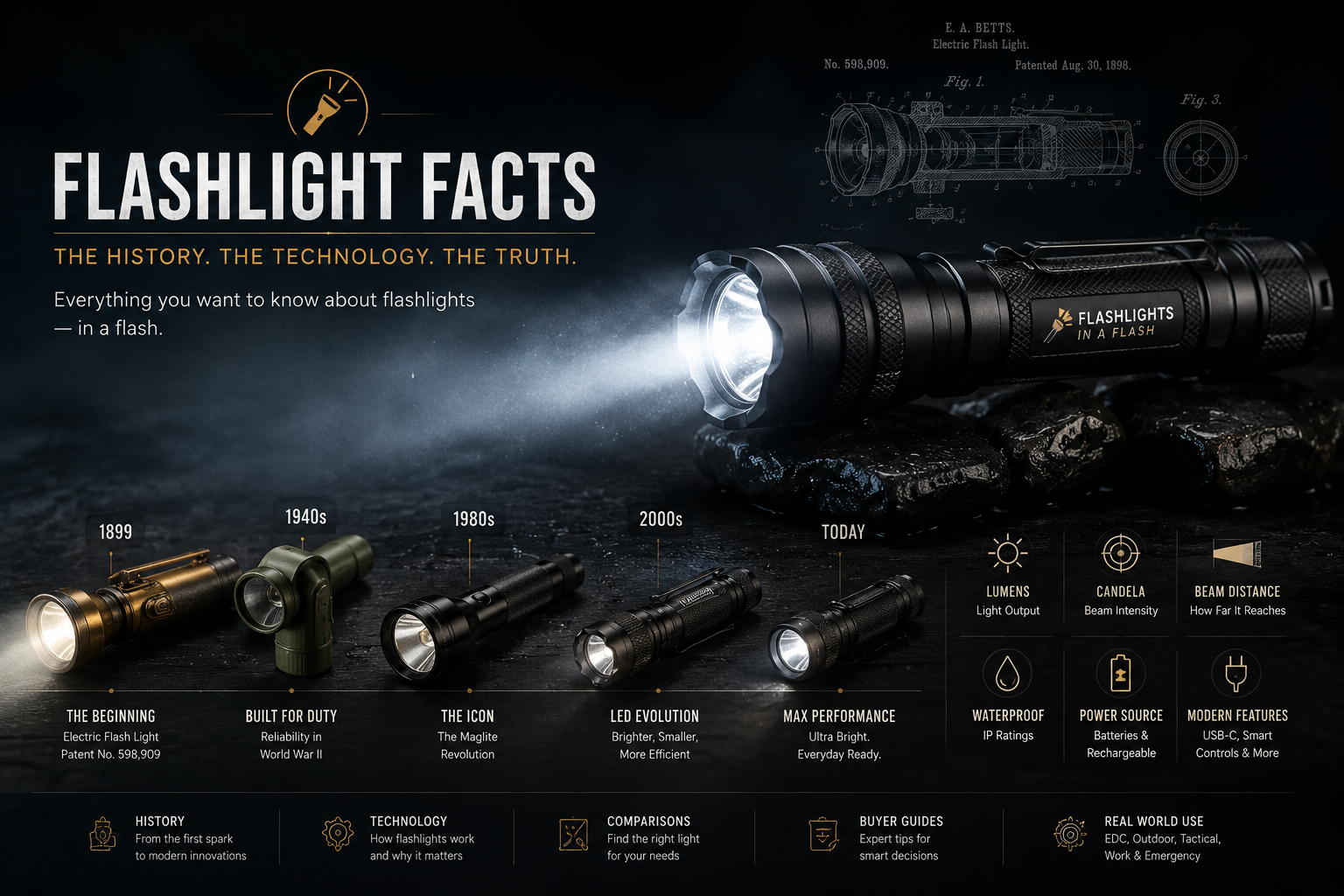
The flashlight was invented by David Misell, a British immigrant living in New York, who filed U.S. Patent 617,592 on January 10, 1899. His design was simple but clever: three D batteries stacked end-to-end inside a paper tube, wired to a small incandescent bulb with a rough brass reflector behind it to throw the light forward. It only worked because of one other recent invention — the dry cell battery, patented in 1887 and mass-produced starting in 1896. Before that, batteries used liquid electrolyte and would spill if you turned them sideways, which made a handheld light pointless.
Misell assigned his patent to Conrad Hubert's American Electrical Novelty and Manufacturing Company, which handed out early units to New York City police officers to prove they worked. Hubert's company later became Eveready.
The name "flash-light" actually came from how these early lights worked: the batteries of the era couldn't sustain a bulb for long, so users would switch it on for a quick "flash" to see, then switch it off again to save power — you couldn't just leave it running.
1899 — David Misell patents the first handheld electric flashlight
1904 — Conrad Hubert's company introduces an on/off switch, replacing the earlier press-to-light button
1930s — First rechargeable flashlights appear
1962 — The first practical LED is invented (used initially for indicator lights, not illumination)
2000s — LEDs become bright and cheap enough to replace incandescent bulbs in consumer flashlights
2009 — ANSI/NEMA FL1 standard introduced, giving every manufacturer a common way to test and label lumens, beam distance, runtime, and water resistance
Today — Compact rechargeable flashlights routinely exceed 2,000–5,000 lumens, something that would have required a spotlight-sized housing 20 years ago
Why Choose LED Flashlights?
Energy Efficiency
LEDs convert roughly 80-90% of their energy into light rather than heat — old incandescent flashlight bulbs did the opposite, wasting most of their power as heat while producing a dim yellow beam. That's the real reason two AA batteries in a modern LED light can outlast and outshine four D batteries in an old incandescent one.
Longevity
An incandescent flashlight bulb typically burns out after a few hundred hours of use, and the filament is fragile enough to break from a single hard drop. LEDs have no filament to break and are commonly rated for 20,000–50,000 hours of use — that's over 2,000 straight days of runtime before the emitter itself is expected to dim significantly.
Brightness
Output is measured in lumens using a piece of lab equipment called an integrating sphere, which captures every bit of light a flashlight produces. Since 2009, most reputable brands test to the ANSI/NEMA FL1 standard, so a "1,000 lumen" flashlight from one brand should genuinely be comparable to a "1,000 lumen" light from another — before that standard existed, manufacturers could and did measure however made their number look biggest.
Eco-Friendly
LED flashlights don't contain the mercury or fragile glass filaments found in older bulb technology, and because they last so much longer, they generate far less bulb waste over the life of the light. Pairing an LED flashlight with rechargeable batteries cuts disposable battery waste even further.
Lumens — Total Light Output
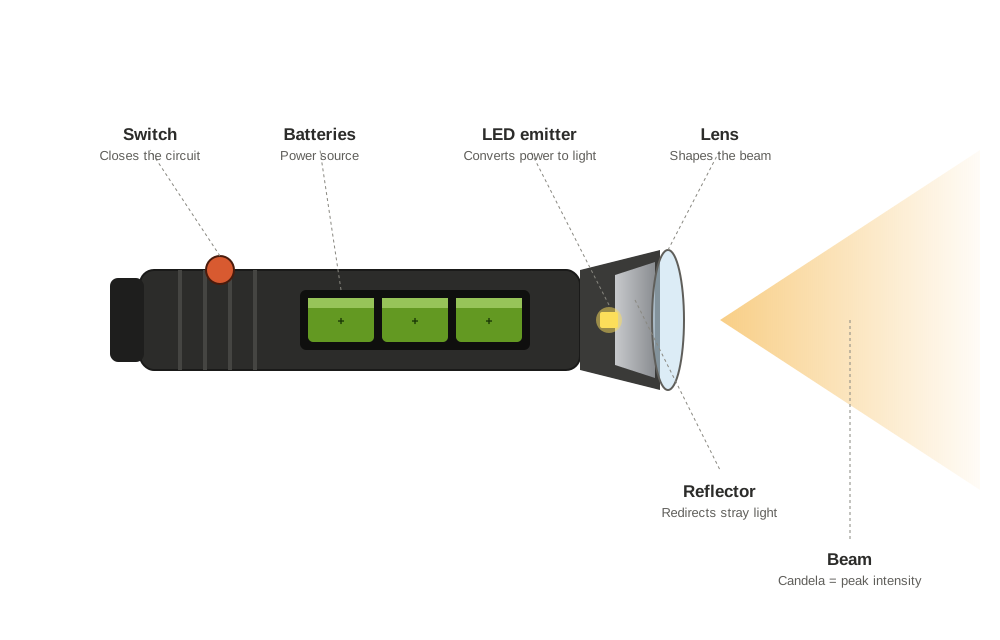
A lumen measures the total amount of visible light a flashlight produces, tested in an integrating sphere. Think of it as the total volume of water coming out of a showerhead — it tells you how much light is available, not necessarily how far it reaches.
Candela — Beam Intensity
Candela measures how concentrated the brightest point of the beam is. A tightly focused "thrower" beam with fewer total lumens can out-distance a wide floodlight with far more lumens. If you need to spot something 200 yards away, candela matters more than the lumen number on the box.
Beam Distance
Calculated from candela, not lumens: beam distance (meters) = the square root of (candela ÷ 0.25). It tells you how far the beam still produces as much light as a full moon on a clear night — useful, but not blinding. Because it's a square-root relationship, you need 4x the candela to double the beam distance, not 2x.
Runtime & IPX Rating
Runtime is tested with fresh batteries, measured from the 30-second mark until output drops to 10% of the initial reading — so "runtime" doesn't mean "still fully bright," it means "still usable." IPX water ratings tell you what the light actually survived: IPX4 is splash-resistant, IPX7 means 30 minutes submerged at 1 meter, and IPX8 means submersion beyond that, at a depth and duration the manufacturer specifies.
Ready to find your light?
Now that you know the difference between lumens and candela, browse our full range of LED, rechargeable, and hybrid-power flashlights to find the right beam for the job.